


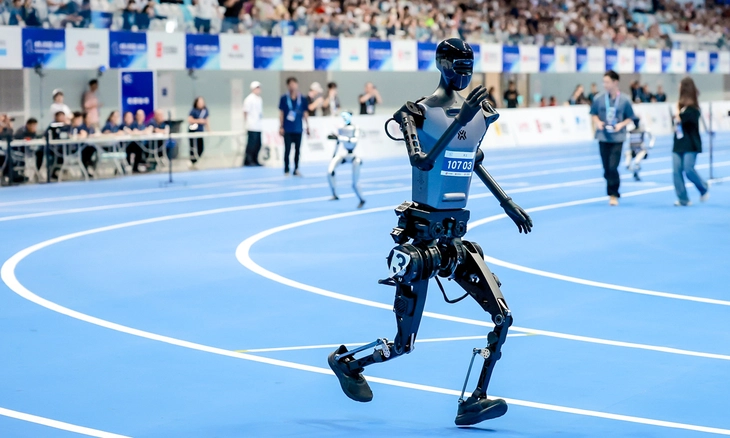
The running segment at the 1st World Humanoid Robotics Championship - Photo: GLOBAL TIMES
The 2nd World Humanoid Robot Games took place in Beijing, China , from August 22 to 26, with a significant increase in scale after just one year of organization.
According to Xinhua News Agency , this year's competition brings together 666 teams with 2,056 robots from 16 countries and territories across six continents. The number of participating teams has increased by 138% compared to the 280 teams in the first season in 2025.
While last season garnered attention with robots sprinting, playing soccer, and occasionally tumbling on the field, this year the organizers want to pose a more challenging question: can humanoid robots truly perform the tasks that humans need them to?
The competition features a total of 51 events, including 30 competitive events and 21 situational challenges. The "robot athletes" will still compete in sports like running, football, or combat sports, but will also be placed in simulated environments such as factories, hotels, homes, offices, and warehouses.
Xinhua News Agency reported that the scenario-based tests were developed based on real-world needs, requiring robots to complete a series of tasks in a complex environment, thereby testing their ability to perceive, make decisions, coordinate movements, and perform precise manipulations.
Some preliminary rounds began on August 16th. According to Global Times , at a real fire station in Beijing, robots had to participate in simulated firefighting tasks, from detecting hazards and using equipment to responding to emergencies.
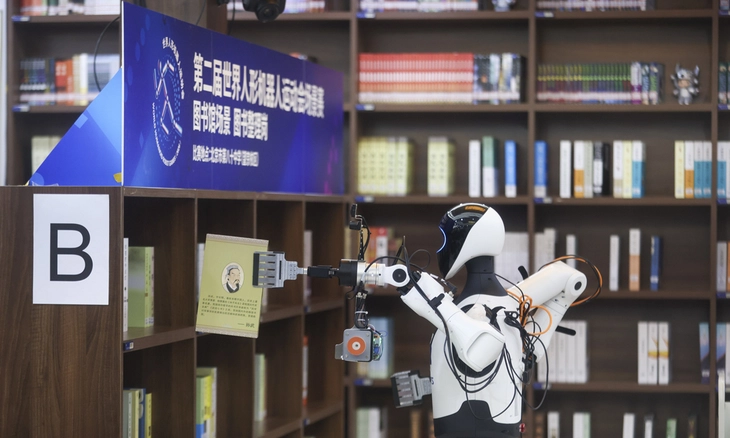
A humanoid robot inspects bookshelves during a library simulation competition at this year's 2nd World Humanoid Robotics Championship - Photo: GLOBAL TIMES
In a simulated office environment test, the robot was assigned tasks very familiar to humans, such as loading paper into a printer, arranging items in a meeting room, and operating a paper shredder, all within 20 minutes. A single mistake or taking too long could affect its score.
This year, the robots even have a similar area called an "athlete's village." According to CCTV Finance , this "athlete's village" is capable of housing more than 1,500 robots and charging at least 1,200 battery packs. The digital management system allows for the receiving or returning of a robot to be completed in about 30 seconds.
The organizers also set up a "Robot Street" featuring smart retail activities, virtual reality experiences, and a cafe served by robots.
Additionally, there is a competition category specifically for robotic hand dexterity, which includes tests of precise manipulation skills derived from industrial production and everyday life.
This is considered one of the most challenging tasks for humanoid robots. Because walking and maintaining balance are only the first steps, to perform real-world tasks, the robot must also be able to grasp, rotate, place, and assemble small objects with the appropriate force and precision.
Change the way we evaluate robots.
According to the organizers, the number of entries this year increased from 487 to 1,301. This larger scale comes with a significant change in how robots are judged.
Wang Peng, an expert from the Beijing Academy of Social Sciences , commented that last year the question was whether the robots could reach their destination. This year, the question has become whether they can complete the job.
Therefore, the medals in Beijing may only be part of the race. The real test lies in how many robots, after leaving the arena, are intelligent, skillful, and stable enough to enter factories, offices, hotels, or real-world rescue sites.