



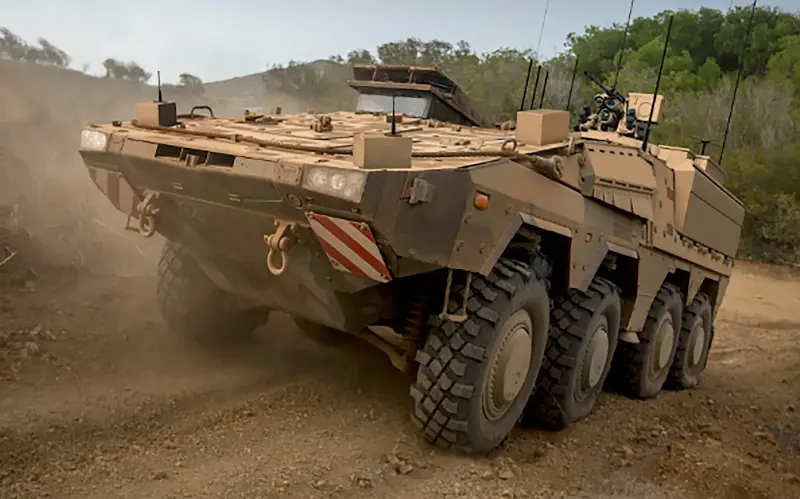
Boxer is an eight-wheeled armoured vehicle of almost 40 tons being purchased for the British Army to replace the ancient FV432, which entered service in the 1960s.
It is built under licence at Telford and Stockport, 623 are on order, and the first 100 have already been handed over. Britain joined the programme, originally a joint German and French project, in the mid-90s and full delivery is expected by 2031.
The vehicle itself is by all accounts pretty solid and the design has been proven on operations, with German Boxers deployed to Afghanistan in several variants. However, the approach to ordering it is so unserious it reflects an army that does not appear to actually expect to fight anytime soon.
Boxer is the Army’s mechanised infantry vehicle, which, as the name suggests, is designed to carry infantry. But on the battlefield you require more than just the ability to carry soldiers. Variants carrying mortars and anti-tank missiles and another kitted out to recover damaged vehicles were planned also, but these have now been scrapped as part of the wider armoured vehicle budget being slashed from over £7bn to just over £5bn.
What have not been scrapped however are the command vehicles (mobile control centres). It is understood that of the around 623 Boxers ordered, 212 will be command vehicles while 146 are infantry carriers, with the remaining vehicles allocated to specialist and medical roles.
Having more command vehicles than infantry carriers is inexplicable, as is leaving the infantry needing to find another means of providing mobile mortar fire. Recovery is just as essential. For an almost 40-ton vehicle, potentially bogged down and damaged, this requires heavy winching equipment and protection for the troops carrying out the work.
With the recovery variant binned, the only conceivable option would be to use the Challenger tank-based recovery vehicles. These, of course, exist primarily to recover Challenger tanks, giving an already smaller fleet much more work. The Army says it is examining a heavy-wheeled recovery vehicle instead, which may well turn out cheaper and better, but it does not exist yet and the requirement has not disappeared with the variant.
The point of Boxer is that it is modular; the chassis and engine make up a drive module and a mission module bolts on top. The whole design exists to make adding a mortar or a recovery module straightforward, and Britain is now actively working against that.
The imbalance is not actually new, recent cuts have just exacerbated it. In a written answer in 2021, the then defence procurement minister, Jeremy Quin, told MPs that the order as it then stood contained 177 command-type vehicles against 85 infantry carriers.
It is remarkable that this mess is not the result of one person or one bad decision. It is the result of an approach that was decided in instalments, over 15 years, by dozens of people who ought to have realised what they were pursuing. An order weighted towards command vehicles was a reasonable thing to own in Helmand, where nobody was shelling British logistics and the enemy had neither armour nor an air force. Given current threats, it is a strange thing to be holding on to.
European armies have, as they often do, gone a different way. Rather than the modular system, France uses different types of vehicles for supporting roles, such as Griffon and Serval, keeping its expensive VBCI hulls for the fighting.
Italy, on the other hand, uses a modular system but properly. It went all in with its Freccia order, including the infantry fighting vehicles, the anti-tank variants and the mortar carriers in its buy.
The net result of this for Europe is that their units are largely set up to fight on arrival. This is not the case for Britain.
George Allison is the founder and editor-in-chief of UK Defence Journal