



As a 30lb pelican marched towards me, chest puffed out and wings splayed like Popeye, I began to regret my decision to spend the day as a St James’s Park keeper.
Dressed in a fish-gut-stained coat and thick rubber gloves, I reached into my bucket to pick out a defrosted trout as a gaggle of tourists gathered for the birds’ daily 2.30pm feed.
My fingers had barely gripped the fish before it was snatched out of my hand, the bird’s rapier beak jabbing upwards towards my neck before gulping its prize down whole.
Pelicans have been a fixture of the park since 1664, when a pair was given to Charles II by the Russian ambassador.
Yet in more than 360 years, they have never bred, with their numbers replenished by donations from zoos around the world.
So when the news emerged last week that four chicks had hatched, birdwatchers and tourists flocked to the park to catch a glimpse of London’s first home-grown pelicans.
“We never thought we’d ever have any pelicans hatch in St James’s Park,” said Mark Wasilewski, who has managed the park for for 30 years. “It has come as a complete surprise to us, and we’re absolutely delighted.”
Nick Burnham, the park’s senior wildlife officer, said: “People are always quite excited to see the pelicans anyway, but it’s definitely ramped up.”
At feeding time, onlookers watched as the birds squawked and jostled to catch fish out of the air.
“It’s great,” said Joanne Chace, a teacher from San Francisco who witnessed the spectacle, while Rachel Isherwood, 27, an NHS worker who had come down on her lunch break, added: “They’re really cool – they’re just like dinosaurs.”
Pelicans have the second-largest wingspan of all living birds, stretching beyond 11ft, while adult males can weigh more than 2st 4lb and eat up to 4lb of fish a day.
The park’s squadron of six adult great white pelicans – Isla, Tiffany, Gargi, Sun, Moon and Star – are being fed twice a day so that they can rotate who feeds while they brood.
Yet despite their voracious appetites, Mr Burnham said the birds can be “really picky”. “Some prefer roach, some prefer trout, and if they’re not hungry, they will spit it out and get something else. They’re complete divas,” he explained.
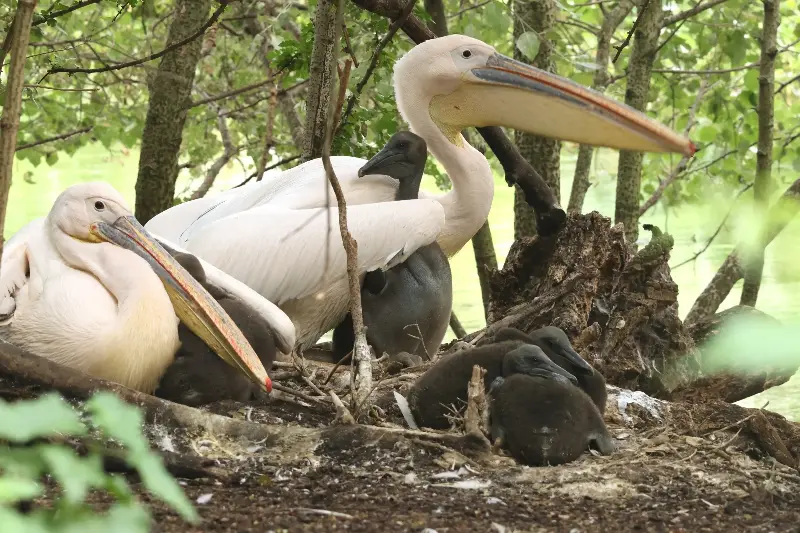
Over on the other side of the park, a short walk from Buckingham Palace, four black, fuzzy pelican chicks can be seen emerging from their nests and waddling close to the water’s edge.
Located on West Island, a secluded nesting spot for the park’s waterfowl, the nests cannot be accessed by land, requiring wardens to wade across the river to keep an eye on the chicks’ progress.
When four eggs hatched in mid-May, the news was kept secret out of concern for the birds’ safety.
“When they first hatch, they come out bright pink, unable to walk, feed, thermoregulate or see very well, so the parents have to do everything for them,” said Mr Burnham.
He first noticed something was up when the birds began displaying nesting behaviours, eating more fish and arriving in groups of three, suggesting they were taking turns to incubate eggs.
Once they had hatched, it soon became impossible to hide the peculiar new arrivals as visitors began asking questions about them. “It was the worst kept secret,” said Mr Burnham.
When The Telegraph visited the pelicans’ nest this week, they had grown and were starting to develop the warbling gullet that makes them so recognisable.
However, it will still be three to four years until they reach adulthood and ditch their downy black feathers in favour of a pearly white plumage.
Amid a flurry of squawking and flapping, their prehistoric-looking parents sailed across the pond, their saggy, pale gullets wobbling as they swam to keep them cool in the summer heat.
Then all of a sudden, one brave chick tottered down to the water’s edge, teetering on the brink like a toddler on a diving board, before taking to the water for the first time.
Having performed a brief pirouette, he rejoined his siblings in the safety of the muddy bank.
“It was brilliant,” said Mr Wasilewski, grinning from ear to ear after witnessing the moment.
Since their arrival in the Stuart era, more than 40 pelicans have lived in the park in varying numbers, the majority of them of the Great White Variety.
Over the years, the birds have never successfully reproduced, with their numbers periodically replenished by donations from Russia, the US and the Czech Republic.
Previous attempts to breed the birds have proved fruitless, including a 1969 attempt by the park’s bird-keeper to build a nest himself.
Will Coster, a project manager at the Wildfowl and Wetland Trust, said that pelicans only tended to breed in squadrons of eight to 10 pairs as a survival mechanism.
“Despite their size, they are big scaredycats,” he said. “In the wild great whites nest in really secluded islands.
“In a captive setting they need to feel safe and secluded from the prying eyes of people and other threats.”
Eggs have an incubation period of 36 days after pelicans lay them. It can then take a further 75 days for the chicks to fledge, at which point they can look after themselves, meaning the whole process requires a substantial investment of time and energy from their parents.
Besides the long incubation period, pelicans must also find a partner they like, explained Mr Coster, or else they will “divorce” and not reproduce.
Despite the birds being monogamous, the St James’ Park keepers have been left bemused as the clutch of chicks has been laid by three mother birds, despite there only being two males in the squadron, suggesting one has not been entirely faithful.
Diet also plays a key role in ensuring the birds breed. Historically, pelicans in the park were fed whatever fish was available – usually saltwater varieties – but research in the 1990s found that great whites are in fact freshwater feeders.
Freshwater fish contain higher carotenoid levels, the same chemical derived from carrots, which gives them a russet chest and head, used as a sign of vigour to entice mating partners.
In the 1950s, Cold War rivalry supposedly led the US embassy to donate a pair of American brown pelicans to the park, not wanting to be upstaged by the incumbent Soviet birds.
However, the American pelicans were purely a saltwater species, and failed to flourish in the British park.
Their arrival also prompted grumblings in the media, with The Daily Express warning: “Next thing we’ll be having GIs on guard at Buckingham Palace.”
There is also the issue of siblingcide, which is common among pelican chicks in the wild, with the larger in a pair often stealing the other’s share before eventually eating them.
However, the park keepers are protecting against this by feeding the birds twice a day to ensure all are given enough food to survive.
Of the current squadron, all have been raised in captivity and had their wings clipped other than Gargi, who was discovered in Southend in 1996 after being blown off course.
While the other birds feed in the park, sometimes diving for carp, she has been known to fly over London Zoo in Regent’s Park to steal fish for lunch and has been seen as far away as Richmond and Staines, up to 20 miles away.
“She came back by herself,” said Mr Wasilewski. “You look very silly trying to chase a flying bird, so we left her to it.”
Although there are no wild populations of pelicans native to the UK, archaeological evidence suggests dalmatian pelicans once made these shores home but were wiped out by the Romans.
If they were to be reintroduced, could they make their home at St James’ Park? “They’re reintroducing the white-tailed eagle down on the Isle of Wight, so I don’t see why not,” said Mr Wasilewski.
Back at the feeding enclosure, Allan Freinkel, 52, who is visiting the park with friends, reflected on the significance of having the birds in the centre of London.
“I feel rather proud that the city does something like that. It’s really worth it,” he said. “Humans need to experience nature, because otherwise we wouldn’t be human.”