



Dolphins have learned to plug the holes in coral outcrops with sponges to prevent fish from swimming to safety, the BBC Blue Planet III team has discovered.
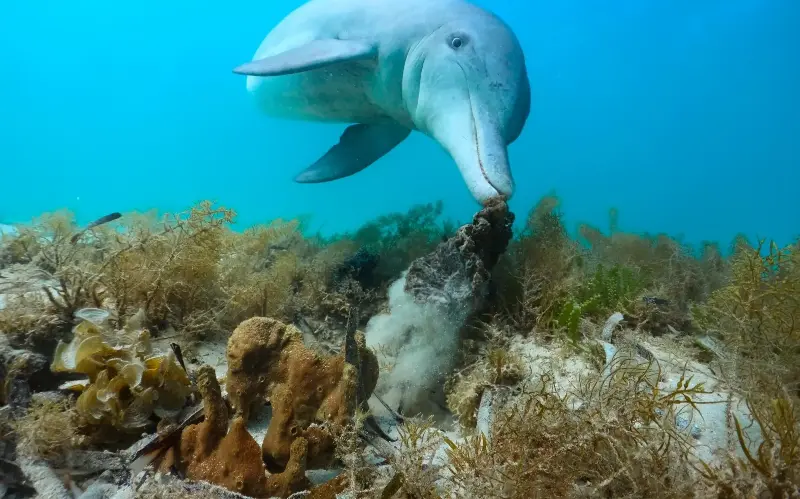
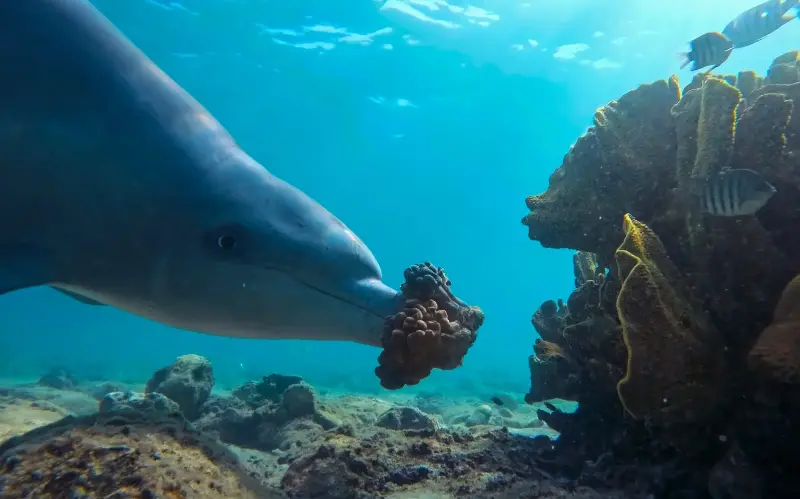
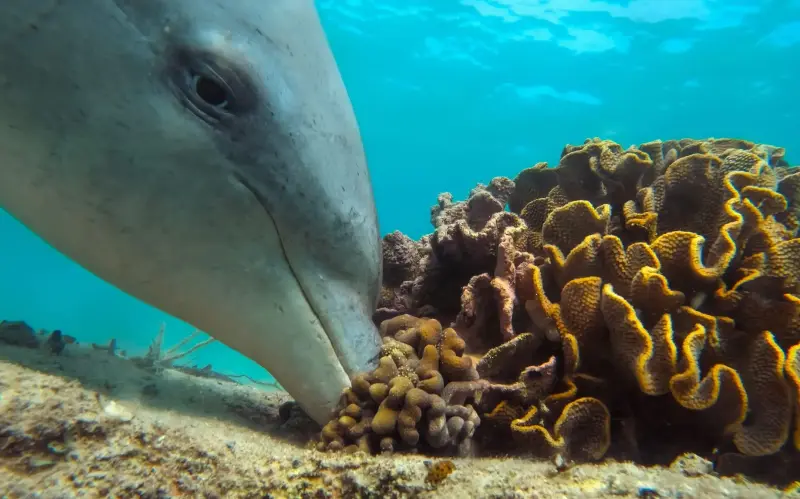
For 40 years, bottlenose dolphins in Shark Bay, Western Australia, have been seen carrying sea sponges on their snouts, in what marine biologists believed was either to attract mates a way to prevent their noses being damaged on the rocky sea floor.
But cinematographers shooting the third Blue Planet series observed that the dolphins were chasing fish to the coral caves where they would hide, then plugging the entrances with sponges, leaving their prey stranded and vulnerable.
“It’s one of the most sophisticated examples of trap-setting in the animal kingdom,” said Sir David Attenborough in the first episode, which focuses on life in the tropical seas and took four years to film.
The sea bed of Shark Bay is littered with coral “bommies”, free-standing pillars of coral that rise from the ocean floor and provide fish with cover from predators.
‘Cultural tradition’
Despite their thin snouts, dolphins cannot reach inside, so have been forced to come up with an ingenious workaround.
Describing the process, Sir David said: “Dolphins have been seen carrying sea sponges. Originally thought to protect their snout when foraging on the seabed, only now do we know the reason is far more complicated.
“(The dolphin) takes the sponge back to the bommie and carefully, deliberately places it in just the right position. She backs off. Far enough for the fish to relax, and with a burst of speed, she sends them fleeing, only to find their hiding place plugged by the sea sponge.
“Only a select few have learned this skill. The cultural tradition passed down from mother to calf that gives these dolphins the edge in this competitive world.”
It is nearly a decade since Blue Planet II aired and 25 years since the first seminal series was broadcast. The episodes have been watched by millions in more than 200 countries and inspired dozens of scientific papers.
Elizabeth White, the show’s executive producer, said: “The Blue Planet was an unbelievably cutting-edge series that captivated audiences because it was the first time we’d really seen the spectacles of the underwater world in a big, blockbuster landmark way.
“I think it’s very easy for people to feel quite anxious at what’s happening in the natural world but there are many positive stories out there.
“The ocean is a place which shows great resilience, if we just give it the chance.”
The first episode of the new series also documents extraordinary co-operation in the animal kingdom, from nurse sharks forming groups to chase fish towards the shore, where they can be hoovered up, to groupers teaming up with moray eels to flush prey from reef crevices.
Off the coast of Bali, starfish must endure harlequin shrimps grouping together to pull off their legs. Fortunately, they grow back.
‘Remarkable intelligence’
Yoland Bosiger, the producer for the first episode, said: “What makes this part of the ocean so fascinating to me is the remarkable intelligence of the animals that live there.
“These hotspots can be intensely crowded and competitive, so to get by, animals often lead highly complex lives – some with surprising parallels to our own.
“The sequence I’m most excited for audiences to see features an Indo-Pacific bottlenose dolphin that we filmed in Shark Bay and reveals exactly how she uses marine sponges to hunt fish.
“It was previously thought that dolphins used sponges to protect their beak while foraging in the sand, but our filming revealed something very different, solving an enduring marine mystery.”
To capture the unique footage, the team developed a remote camera system, nicknamed Stonefish, which allowed them to keep watch beneath the surface for 24 hours at a time so that rare or fleeting behaviour was not missed.
Cameras were also mounted to underwater scooters to record the fast movement of darting fish.
Later episodes capture life in the seas around Antarctica where giant sea spiders roam and ancient glass sponges and tiny amphipods hitch rides on jellyfish and sea angels to danger.
In Japan, an octopus was filmed risking its life by leaving the water to hunt on land, ending up in a race against time to reach the sea again before it dried out in the summer sun.
“My hope is that audiences come away with a sense of how extraordinary, complex and intelligent the animals in the tropical seas are,” added Mr Bosiger.
“Fish are often underestimated and I hope seeing their sophisticated behaviour encourages us to think more carefully about our choices, including what we eat.”
Blue Planet III starts on Sunday Nov 1 at 8pm, on BBC One and iPlayer